Shoe-size numbers do not convert exactly between markets, so plan a sock range from foot length. Group foot lengths into a few bands (for example S, M, L and XL). Show each band in the systems your customers use: EU, UK, US men's and US women's, with the size system explicitly identified for Australian customers. Print the same band on the sock label, the pack, the carton and the product page, and approve finished measurements on samples.
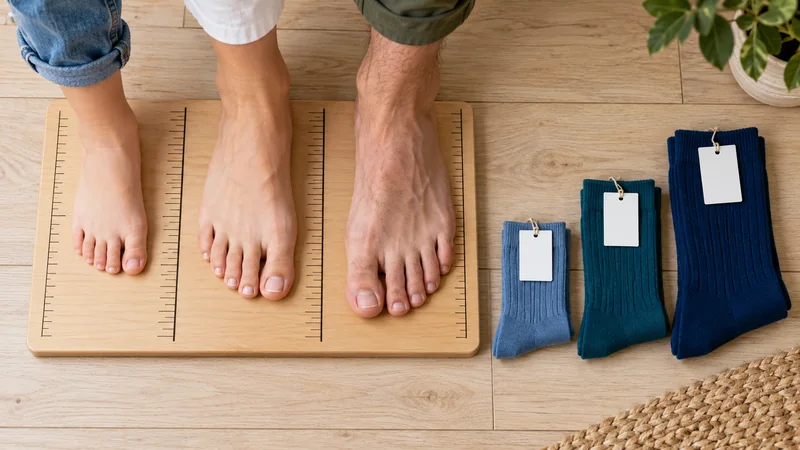
A brand selling in more than one country soon finds that "size 8" means different things. A UK 8 and a US men's 8 are different sizes, a US women's 8 is smaller again, and the EU uses a different scale entirely. Socks add one more layer, because each sock size covers a range of shoe sizes. This guide explains how to turn those systems into one consistent size range. Our Samples & MOQ page covers how the number of sizes affects order quantities.
Use the fillable size confirmation worksheet
Shoe size conversions are approximate and vary between brands and footwear types. The chart below is an illustrative planning mapping, not our size chart and not a fit guarantee. Final size charts, finished measurements and labels are agreed for each style on physical samples.
Sock size vs shoe size: are they the same?
No. A sock size usually covers a range of shoe sizes, and its label may use a different numbering system. Do not read a sock-size number as the identical shoe size. For a sock size to shoe size conversion, find the manufacturer’s stated shoe-size range, check the market and men’s or women’s scale, and compare it with measured foot length.
Use the illustrative conversion chart to plan the labels, then record the actual style-specific range in the sample confirmation worksheet. Fit and stretch vary between Pilates grip socks, cycling socks and football grip socks, so approve the finished sample for each range.
1. How the four size systems work
Each system was built on its own unit, which is why the numbers never line up neatly:
- UK counts in barleycorns (a third of an inch). Children's sizes run up to 13½, then adult sizes start again at 1. Men's and women's adult sizes broadly share one scale.
- US uses a similar step but a different starting point, and separates men's and women's scales. Use the chosen brand's men's or women's conversion chart: the offset from UK sizing is not a universal rule for every footwear range.
- EU (Continental) counts in Paris points (two-thirds of a centimetre) and uses one scale for men and women, typically from the mid-30s to around 50 for adults.
- Australia is a retail market, not a single sock-size scale. Australian brands may show UK, US or EU footwear ranges. Check the named system and wearer group on the product's chart before converting or printing labels.
Foot length is the common reference behind all of them. The Mondopoint system (ISO 9407) labels footwear directly by foot length in millimetres. That is why foot length makes a reliable base for a multi-market sock range.
2. Start from foot length
Define each size band by a foot-length range first, then add the shoe-size labels. To collect foot lengths from wearers, testers or a team:
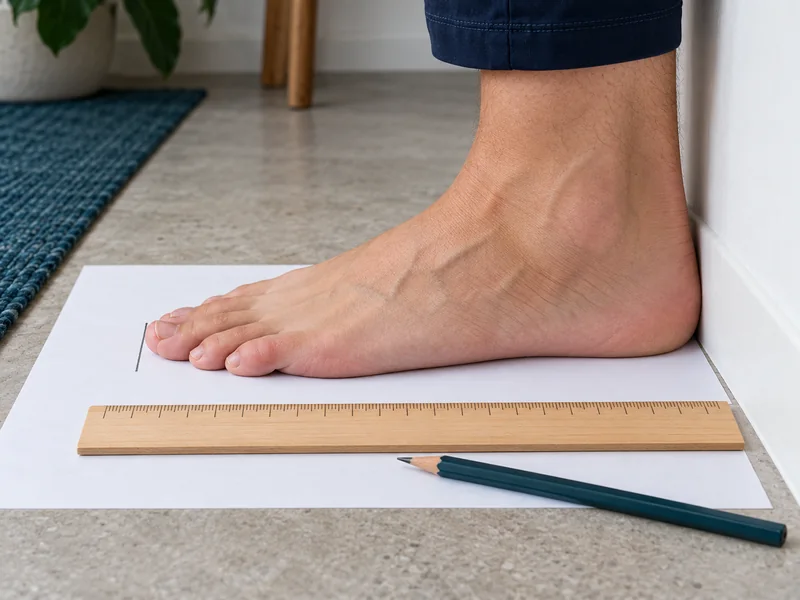
- Stand with the heel against a wall, weight evenly on both feet.
- Mark the tip of the longest toe and measure from the wall to the mark.
- Measure both feet and use the longer measurement.
- Measure later in the day, when feet are usually at their largest.
For a retail brand, collect foot lengths alongside the customer's usual shoe size, brand and size system. A shoe-size range alone does not identify one exact foot length. For a club or team, collect foot lengths directly, then use the chart below to plan the size-band discussion.
3. An illustrative sock size conversion chart
The mapping below groups adult foot lengths into four 2 cm bands, a common structure for sports socks. The illustrated size guide on our ribbed training grip socks page uses the same EU groups and foot-length ranges. That page also notes that the final UK, US, EU or Australian mapping is agreed for each customer group before labels are printed.
| Band | Foot length (approx.) | EU | UK example | US men's | US women's example |
|---|---|---|---|---|---|
| S | 22–24 cm | 35–38 | 2½–5½ | 3½–6½ | 4½–7½ |
| M | 24–26 cm | 39–42 | 6–8½ | 7–9½ | 8–10½ |
| L | 26–28 cm | 43–46 | 9–11½ | 10–12½ | 11–13½ |
| XL | 28–30 cm | 47–50 | 12–14 | 13–15 | Usually not needed |
Illustrative planning mapping only. Shoe-size conversions vary between brands; use this to frame a discussion, then approve your own size chart on samples. The UK and US columns are examples, not an Australian conversion rule. Confirm the systems used by the destination retailer and the selected style.
How to convert EU sock sizes to UK sizes
Read the EU range on the sock pack, then find the matching range in the same brand’s UK shoe-size column. Check both ends of the band: a sock labelled EU 35–38 covers several shoe sizes, so it cannot be converted into one UK number. Confirm whether the chart is for adults or children before using it.
For example, the illustrative adult chart above places EU 35–38 alongside UK 2½–5½. That is a planning example, not a universal conversion or an approved size specification for every sock on this site. For an existing pair, use that product’s chart. For a new club, studio or retail range, record the proposed UK and EU labels with measured foot lengths in the size confirmation worksheet, then check fit at both ends of each band.
How to read European sock sizes in US sizes
To compare EU sock sizes with US sizes, find the EU range on the pack, then read across the same row of the supplier's chart. Check whether the US column means men's or women's sizes: they are different scales. A range such as EU 39–42 describes several shoe sizes, not one exact US size.
- Measure foot length in centimetres and compare it with the stated sock band.
- Use the matching US men's or US women's column; do not convert by subtracting one fixed number from the EU size.
- At a band boundary, compare both adjacent samples in the intended shoes. Confirm the chosen range before printing labels.
The table above is an illustrative adult planning chart. Record your agreed EU, US, UK and Australian labels in the size confirmation worksheet; use the approved style-specific chart for the finished product.
How do you convert US sock sizes to Australian sizes?
Start with the size system on the Australian product, not the country name alone. A US men's range, US women's range and UK range are different references. A sock label also covers several shoe sizes, so there is no single US-to-AU subtraction that works for every pack.
- Check whether the original number means a sock size or a shoe-size range, and whether it is for adults or children.
- Find the Australian retailer's chart and identify its UK, US men's, US women's or EU column. Use that same chart for the comparison.
- Match the stated range to measured foot length, then check fit on the intended sock sample. For a unisex range, label men's and women's scales explicitly.
For example, Clarks Australia publishes separate men's and women's footwear charts with UK, EU and US columns. These illustrate why the brand and wearer scale matter; they are not size specifications for our socks.
For an Australian studio or club order, record the agreed label system, foot-length bands and sample version in the size confirmation record, then use those same bands in the studio order or team allocation.
4. Men's, women's and unisex labels
The most common labelling problem is a unisex band that shows only one gender's numbers. A woman who wears a US 8 and sees "US 7–9½" on a pack may pick the wrong band, because that range is in men's sizes. Options:
- Unisex range, both scales. Print men's and women's ranges for each band, using the format "US men’s [approved range] / US women’s [approved range]". This is the clearest option for most sports socks.
- Separate men's and women's ranges. Useful when the styles differ in fit or colour, but it adds lines and reorder records.
- Letter only (S/M/L). Avoid this on its own. Letters mean different things across brands, so always add the numeric ranges.
Even within one catalogue, letter ranges differ by style. Our ribbed crew yoga grip socks and blank ribbed crew socks plan sizes from XS to L. The striped crew yoga grip socks plan S to XL. If you combine styles in one range, line the bands up by foot length before you print a shared size chart.
5. Youth and children's sizes
Children's shoe sizes use separate scales in the UK and US, and adult sizing restarts after the largest children's size. Conversions between markets are even less consistent than for adults. Define youth bands by foot length, use age only as a secondary guide, and check whether youth bands should overlap with your adult S. If your range includes youth sizes, product pages such as our crew football grip socks and cotton-blend blank crew socks show how youth-to-adult planning is presented. Final measurements are confirmed on samples.
6. How many bands should the range have?
Each band is a separate size line for every style and colour, so the number of bands sets the size of the order as well as the fit:
| Structure | Fit | Order and stock |
|---|---|---|
| 2 wide bands | Each band covers about 4 cm of foot length; check the ends of each band carefully. | Fewest lines and simplest restocking. |
| 3 bands | A common middle route for adult ranges. | One more line per colour than two bands. |
| 4 bands (S–XL) | Closer fit across a wide adult range. | More lines; check your own customer data before adding an XL band. |
For standard grip styles, the published minimum applies to each style, colour and size, so adding a band adds a full line in every colour. Other sock types are quoted for their own construction. See Samples & MOQ for how lines are counted.
7. Keep labels consistent everywhere
Once the bands are set, the band is the product. The same band should read the same way wherever the customer, the warehouse or a retailer meets it:
- Sock and pack labels: the band letter plus numeric ranges in the systems you sell in. Use a fixed order, such as EU / UK / US.
- Product pages and size charts: the same ranges as the pack, plus foot length.
- Cartons and allocation sheets: the band letter and colour, matching the pack.
- The specification: band boundaries, finished measurements and label artwork recorded with the approved sample. If you change a boundary later, treat it as a new version, not a reorder.
8. Selling to European retailers
"Europe" is not one size market. Sizes, pack labels and reorders are easier to keep consistent when you plan by country and by retailer:
- Name the countries. List each destination country and retailer before setting the labels. A range for German, French and Dutch retailers needs different pack wording from a range for the UK and Ireland, even if the sock is the same.
- Lead with EU sizes on the continent. EU shoe-size ranges, such as the 35–38, 39–42 and 43–46 groups in the illustrative chart above, are a common reference for continental European packs. Numbers need no translation, which keeps one pack usable across several countries.
- Add UK sizes for the UK. UK and Irish shoppers commonly look for UK sizes, so a pack sold there should show the UK range as well as EU. Great Britain also applies its own textile labelling rules; see our guide to selling to European retailers.
- Ask each retailer for its band split. Some retailers specify their own size steps, pack format or size wording. Collect these before the pack sample so you are not printing a different band structure for each customer later.
- Translate the words, not the bands. Keep the band boundaries the same in every country and translate only the text around them. In the EU, fibre composition must be labelled in the official language or languages of the Member State where the product is sold, unless that state provides otherwise (Article 16, Regulation (EU) No 1007/2011). A multilingual pack can cover several countries if every required language is included.
| Decision | Confirm with each retailer | Keep the same everywhere |
|---|---|---|
| Size labels | Which systems to print (EU only, or EU and UK) and any required size wording. | Band boundaries by foot length and the order of systems on the pack. |
| Pack text | Languages for composition, care and any other pack wording. | The confirmed composition and care instructions behind the translations. |
| Pack and barcode | Pack format, barcode type and carton labels. | The approved sock and size chart. |
| Size mix | Pairs per size from that retailer's own sales or forecast. | The minimum per style, colour and size line. |
Each pack version that differs, for example an EU-only pack and an EU-and-UK pack, is its own line in the reorder record. Our wholesale and distribution page covers distributor packs, channel-specific colour sets and version records. Check the current rules for each country with your compliance adviser before printing.
9. Confirm the fit on samples
A converted number is only a starting point. Knitted socks stretch, and the same nominal size can fit differently depending on yarn, knit and height. On samples of each band, check:
| Check | Include in your brief | Approve on the sample |
|---|---|---|
| Band boundaries | Foot-length ranges and the size systems to print. | The final size chart for this style. |
| Finished measurements | Any target sock foot length, leg length or cuff width. | Flat measurements per band, recorded in the specification. |
| Fit at the ends | Testers at the smallest and largest foot in each band. | Heel position and toe room on both testers. |
| Grip placement (grip socks) | Sole pattern reference. | Pad or dot placement under the foot on every band. |
| Labels | Label and pack artwork for each band. | Size information that matches the chart exactly. |
Our customization page treats size labels and size identification as part of the packaging specification. Our product pages note that illustrated size labels are planning references until the sample fit is approved. To check whether sizes still fit after washing, see how to check shrinkage and fit.
Complete a size range confirmation record
Use one record for each style and sample version. Keep the agreed size chart, label artwork and fit observations together; do not copy the illustrative conversion table into a production specification without confirming the fit. For venue quantities and packing, continue with the venue order record.
Size range and sample confirmation record
Build your own style-specific record. Start with foot lengths in millimetres, then enter the labels and sample observations you want to review. Leave anything unconfirmed blank.
Entries stay in this page and are not sent to us or saved by this tool. Download your record before leaving. All fields are optional; blank fields remain unconfirmed.
Start with the details you know.
This is a planning record, not a quotation or supplier approval. To discuss it, copy the relevant entries into the quote form, or print to PDF and attach that file there.
Frequently asked questions
Are sock sizes the same as shoe sizes?
No. A sock size normally covers several shoe sizes, and the number or letter on the label may follow a different system. Use the stated shoe-size range for the correct market and wearer scale, compare measured foot length and confirm fit on a sample. Do not assume that a sock-size number equals the same shoe-size number.
How do I convert EU sock sizes to UK sizes?
Use the sock brand’s chart to match both ends of the EU range to its UK shoe-size column, checking whether it covers adults or children. EU 35–38 is a range, not one UK size. The UK 2½–5½ band in this guide is an illustrative example only; check the selected style’s chart and sample fit before buying or printing labels.
How do I convert European sock sizes to US sizes?
Check the EU shoe-size range on the sock pack, then use the same brand’s chart and the correct US men’s or women’s column. EU and US numbers are not a fixed subtraction, and a sock band covers several shoe sizes. For a new product range, confirm foot length in centimetres and fit on samples; the table above is an illustrative planning guide.
How do UK and US sock sizes compare?
UK and US shoe-size numbers are different, and US men's and women's sizes use separate scales. Use the same brand's chart for the correct wearer group; do not apply one fixed offset to every sock pack. Confirm foot-length bands and fit on samples before printing both systems.
What size system does Australia use for socks?
Australian sock brands may label their products with UK, US or EU shoe-size ranges. Check the system and men's, women's or children's scale on the brand's chart. For a new range, confirm foot-length bands and sample fit, then use the agreed labels consistently on the sock, pack and product page.
How do I convert US sock sizes to Australian sizes?
Check whether the US number is a sock size or a shoe-size range, then identify the scale used by the Australian product: UK, US men’s, US women’s or EU. Use that brand’s chart and measured foot length, rather than a universal subtraction. Confirm the sock fit on a sample before approving labels for a studio, club or retail order.
What does sock size M usually cover?
There is no universal definition. In the illustrative four-band mapping above, M covers about 24–26 cm of foot length, EU 39–42. Always define your own bands and show the numeric ranges, not only the letter.
Should we print EU, UK and US sizes on every pack?
Print the systems used in the markets where that pack is sold, in a fixed order. A pack sold in several markets usually carries EU, UK and US ranges, with men's and women's US ranges for unisex bands.
Is your size chart the same for every style?
No. Illustrated size labels on our product pages are planning references. The final size chart, finished measurements and fit are confirmed for each style and order on physical samples.
Next steps
Apply the agreed size bands to your buying plan: allocate trampoline park pairs by size and location, plan studio retail quantities, or record football and soccer team fit trials. A conversion chart helps label the range; each selected sock construction still needs its own fit approval.
Choose your bands, then check how they affect quantities on Samples & MOQ. Planning a first retail range? Our guide to how many colours and sizes a new sock brand should stock applies the same line count. Send your markets and size list through the quote form.